
What ODRC Mugshots Represent
ODRC is Ohio's prison agency. The full name is the Ohio Department of Rehabilitation and Correction. It publishes a statewide offender search. A profile can carry an official image labeled "Offender Photo." It may also show status and correctional details. This is the state layer of Ohio records. It sits apart from a county jail roster. A city booking record and a federal custody locator sit apart from it too.
An ODRC mugshot is just the familiar name for that profile image. The agency itself calls it an offender photo. Nothing on the page says the picture came from a first county arrest. Local agencies take booking photos at intake. The person may later be sentenced to an Ohio prison. Then ODRC creates a separate correctional profile. The two images can come from different events. They may also come from different custodians.
The search earns its keep in certain cases. Someone may be in an Ohio prison, under supervision, or judicially released. It does not replace a county booking record or a court docket. A listed offense or sentence is just an agency record. Where the question matters, check the court's own case history.
Search the ODRC Offender System
Begin with the official ODRC offender search. The form offers several fields. Combining them helps you sort through common names. Even so, a shared name does not settle who the result belongs to. Compare the offender number and the other details the agency displays before treating a result as the person you mean. County of commitment and residential county answer different questions. Neither one shows a current location.
| Search field | What it does |
|---|---|
| Last name | Searches by family name. Results may include related spellings and suffixes. |
| First name | Can be combined with last name to narrow the list. |
| County of commitment | Finds people sentenced from that county. It is not necessarily the person's home county. |
| Residential county | Uses the county recorded as residence. That entry may be old. |
| ZIP | Uses the recorded ZIP code, which may not reflect a current address. |
| Status | Filters the categories All, Incarcerated, Released, APA Supervision, and Violators at Large. |
| Next parole-board hearing month | Accepts a year and month in YYYYMM form when that field is used. |
| ODRC number | Searches by the person's agency-assigned offender number. |
The linked ODRC search screen displays its filters and spells out limits on name and county searches.
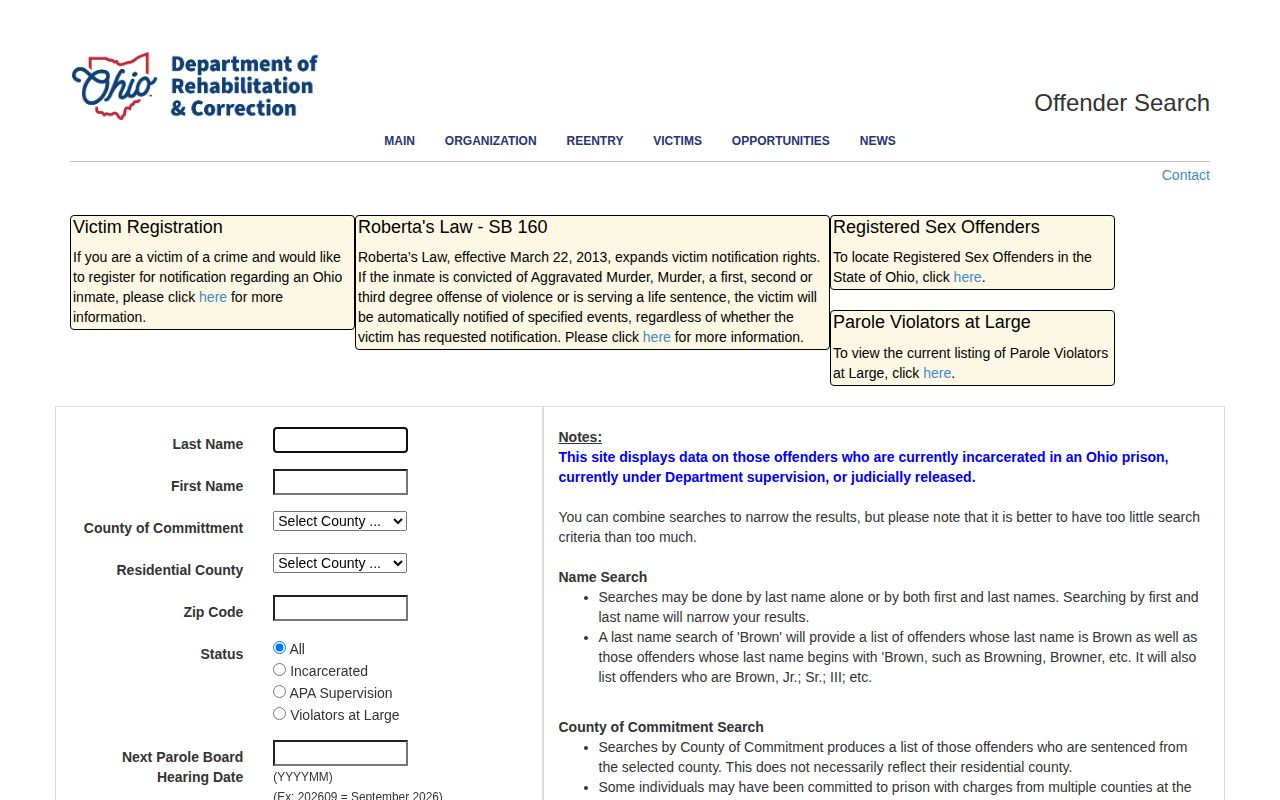
The image shows a search form and instructions. It is not an offender photo or a list of people. Go to the official profile for anything result-specific.
A careful search follows a simple order:
- Choose a last name, then add a first name, status, or other filter only when it helps narrow the result.
- Read the agency's notes about the selected search fields, especially the difference between commitment county and residence.
- Open a likely profile and compare the ODRC number and available record details before relying on the result.
ODRC warns that too many criteria can return too little. If a search comes back empty, loosen the fields one at a time. Try a spelling variation too. Or ask the department for help. An empty result does not mean the person was never in custody. A county jail could still hold them. Another state's prison system, federal authorities, or an office whose record lags could too.
ODRC Status Choices Explained
The status menu casts a wider net than current inmates. It offers five choices. Each label names a record category kept by the agency. It does not settle a court question. It will not fix current whereabouts or prove a new offense occurred.
| Status | How to read it |
|---|---|
| All | Searches across the status options supported by the public system. |
| Incarcerated | For people the system lists as currently incarcerated in an Ohio prison. |
| Released | For a person whose profile is marked released. This does not mean wanted or currently under prison custody. |
| APA Supervision | For people listed under Adult Parole Authority supervision. |
| Violators at Large | A public ODRC status for a person the department identifies as violating supervision conditions and at large. |
APA stands for the Adult Parole Authority. Supervision is a correctional status, separate from any arrest charge or court disposition. A Released label can linger because ODRC keeps profile history. That word alone does not mean the person is wanted or dangerous.
Violators at Large calls for extra care. The label is a public notice. It is never an invitation to approach, follow, or detain anyone. Need a status corrected? Contact the responsible authority or a lawyer. ODRC's completeness warnings matter because the agency says its data may lag.
Note: A person's absence from a status-filtered result may reflect a search limit, data lag, or custody in another agency's system.
Reading an ODRC Offender Profile
Open the official detail page only after the number and other identifiers check out. A profile can show plenty. Expect the "Offender Photo," offender number, admission date, status, institution or supervision details, offense and sentence information, county, and docket data. Fields depend on what the department has. The public site also warns about completeness. A blank field is not a reliable answer to a question the record never addresses.
- Offender Photo
- The image shown on the ODRC profile. It is the department's profile image, not automatically the original county booking photo.
- ODRC number
- The department's identifier for a profile. Use it to distinguish people with similar names and when asking ODRC about a record.
- Admission date
- The date recorded for admission into the department's correctional system. It is not necessarily the date of a county arrest.
- Status and institution or supervision information
- The public category and correctional placement or supervision details provided by ODRC. They may not be a real-time location update.
- Offense, sentence, county, and docket details
- Correctional and case-related information shown in the profile. Confirm the legal outcome in the court record.
Never treat a profile photo as a current likeness. Appearance alone is a poor way to match identities. The record's number and data fields tell profiles apart far more safely. For a serious records question, save the official page URL and the date you checked. Take the question to ODRC or the court.
ODRC Photos and Former Profiles
ODRC's search covers more than current inmates. Visitors can pull former profiles under Released, along with people listed under APA Supervision or flagged as Violators at Large. The database mixes current prisoners with older cases. Statuses shift as people move through the system. A Released label is not a wanted notice. An APA Supervision status is not a new arrest either. Anyone quoting a parole-violator tag should credit ODRC and note the date on the page.
Photos age too. ODRC publishes no fixed schedule for refreshing images or status data, so a profile picture can linger long after a person's appearance or custody has changed. Treat any image as the photo ODRC displayed, not a guarantee of how someone looks now. The underlying record data changes as well. County jails run their own photo policies. Do not read ODRC practice as county practice.
Location fields carry their own drift. ODRC defines county of commitment as the county that imposed the sentence, while residential county and ZIP come from recorded address data. Neither is a live address. An old location is not an invitation to contact or approach anyone.
Note: ODRC's own date and completeness warnings belong with any description of a profile or status.
ODRC Photos vs County Booking Images
A county booking photo and an ODRC profile photo answer different questions. The county image comes from local intake. ODRC's photo belongs to the state correctional record. One agency owns each picture. After court and sentencing a person can pass between systems, but the two images are never interchangeable.
| Record | Custodian | What it covers |
|---|---|---|
| County booking photo | Arresting agency, county sheriff, or jail | A local arrest or booking, subject to that custodian's policy and legal limits. |
| ODRC offender photo | Ohio Department of Rehabilitation and Correction | A profile in Ohio's state prison and supervision system. |
A county roster can list someone who never reaches state prison. The reverse gap happens too. Someone in ODRC custody may drop off the local jail's current roster, while the county's older booking record stays with that agency. To trace the county side, open the Ohio County Directory and pick the place tied to the arrest or booking.
Neither system holds everything. ODRC does not keep every county booking image. County jails do not carry ODRC offender photos. When the custody layer is unclear, check both the local agency and ODRC, then ask the court clerk to confirm the case path. A profile vanishing from one system proves nothing about release, dismissal, sealing, or expungement. That answer lives with the court.
Request an ODRC Record or Photo
When a public profile is missing, incomplete, or disputed, take the question to ODRC rather than a county sheriff. The department's contact page leads to its contact information and Central Records route. Ohio's public-records law is the usual starting point. The statute is R.C. § 149.43. ODRC files face a stricter rule. A narrow request helps the custodian separate releasable items from protected ones.
- Identify the person by ODRC number when available, and give a name only as added context.
- Describe the exact record or photograph sought and provide a relevant date range.
- Send the request through ODRC's listed public-records or Central Records contact route, not to a county address.
- If the department withholds or redacts part of the request, ask which legal limit applies and whether a releasable copy is available.
For ODRC public-record matters, the department lists this contact:
Ohio Department of Rehabilitation and Correction
P.O. Box 430
Columbus, OH 43216
Phone: 614-752-1161
ODRC posts no set fee or turnaround time. Business hours are not listed either. Confirm current instructions with the department before sending anything. The address and phone number apply to state correctional records only. They are not statewide contacts. No county sheriff, jail, police agency, or court answers through them.
Confidential material is a different matter. Medical, disciplinary, security, and investigatory files are not open just because a profile is public. Name the exact record you want. Let ODRC weigh its legal status before release. For how a case ended, whether by plea, dismissal, or acquittal, the court record beats a correctional profile.
Ohio Law and ODRC Record Limits
Ohio's public-records statute, R.C. § 149.43, opens most records held by public offices to inspection, with listed exceptions. A booking photo can fall inside that universe. Yet no state rule compels any county to publish a photo feed. Each custodian reviews the actual record. ODRC adds its own overlay. Under R.C. § 5120.21, many department inmate records are confidential for public-records purposes, though certain identifying and correctional information stays releasable. That is why the offender search is a defined department service. It does not promise that every file behind it is open. A visible profile does not turn medical records, disciplinary files, internal reports, or every photograph into public material.
Other limits reach further. Juvenile material, victim and witness identities, personal identifiers, safety details, and active investigative work can all be withheld. Sealing or expungement orders count too. A requester may ask for the releasable portion and the legal basis for any redaction or denial. An ODRC page cannot override a court order. Protected material does not become public just because a page displays it.
Charges tell only part of the story. A charge can shrink or vanish in court. Quote the court disposition when one exists. Until then, treat the case as pending.
Check Courts and Federal Custody Separately
A jail roster or an ODRC lookup will not hand you a full court history. Ohio simply has no single free statewide trial-court docket. Each county's clerks hold that material. The Ohio Courts site describes the state's shared court applications, including the Ohio Courts Network. Access has limits, though. Membership in the network does not mean every resident can open every county case file or image. For local courts, the Supreme Court of Ohio courts-by-county directory is the practical starting point. Need a case outcome? Go straight to the municipal court or the county Common Pleas clerk tied to the arrest.
Pull the case number first. Then track the filing date, arraignment, bond, plea, dismissal, verdict, sentence, and any sealing or expungement order. Municipal court and Common Pleas are two different courts. A name-only match can point to the wrong person entirely. Weigh case details against booking details first. The Supreme Court's own docket and opinions cover only matters before that court, never the trial dockets behind a county arrest.
Federal custody sits in a world of its own. The Federal Bureau of Prisons locator tracks federal prison inmates, not Ohio county bookings. It offers no public mugshot feed. BOP's records information spells out what the locator cannot do. Its FOIA page lays out the federal request route for anything more. One quirk to expect: a federal prison profile may lack a photo even when an Ohio agency once took a local booking photo of the same person.
The ICE Online Detainee Locator is another narrow federal tool, this one for immigration custody. It usually demands an exact name plus country of birth, or an A-number plus country of birth. Sometimes it also wants a date of birth. Timing and coverage gaps make it nothing like an Ohio arrest feed. The agency publishes no ICE mugshot feed for the public.
U.S. Marshals notices form a fifth, equally narrow channel. The agency's prisoner photography policy and booking-photography disclosure policy both state that federal prisoner photos are not a general public feed. A specific fugitive notice may carry an approved image or an age progression. Even then, that picture is not an Ohio county booking photo.
Match the tool to the question. County offices answer local bookings. ODRC handles Ohio prison records. The local clerk settles court outcomes. Federal tools cover federal custody. These systems overlap across one person's history, yet none of them share a universal search or a common update schedule.