
Ohio's Public-Record Answer
Ohio answers this record by record. The Public Records Act, R.C. § 149.43, gives the public a broad right to inspect and copy records a public office keeps, including a booking photo made by an Ohio arresting agency. But the custodian still applies exceptions. Court orders, juvenile rules, and protections for victims, witnesses, safety, or sealed material can all limit release. Nothing statewide forces every county jail to run a public photo feed.
What one sheriff's portal shows reflects that office's own choice. It proves nothing about other counties. It can't vouch for currency either. A current roster lists people held now and omits many who were released. Custody is its subject, not history. Older entries belong with the agency that created or now holds the record. Court outcomes live in the docket. So use both sources. The booking page shows the arrest; the court file shows what happened after.
Important: A charge can be reduced or dismissed. Check the court disposition, the court's final recorded outcome, before drawing a conclusion from a booking entry or image.
Ohio's Paid-Removal Mugshot Rule
Ohio Revised Code § 2927.22 carries a long title. It covers soliciting or accepting a fee to remove, correct, modify, or refrain from publishing criminal record information. House Bill 6 of the 132nd General Assembly created it. The bill passed in March 2017. It took effect January 18, 2018. The law defines a booking photograph. It is a photo of a person taken in Ohio by the arresting law-enforcement agency. The subject individual is the person arrested and photographed during processing. Criminal-record information covers more. It includes that person's name, address, filed charges, or description. The coverage applies when the publisher asserts or implies illegal conduct. The target was plain. Some sites left arrest material online after a case ended. They then sought money to change or remove it.
The central ban is narrow but sharp. Anyone who publishes or shares that information may not negligently ask the subject, directly or through an intermediary, to pay. That applies in print or online. Nor may that person negligently accept payment to remove, correct, modify, or refrain from publishing it. Each payment counts separately as a first-degree misdemeanor. A harmed subject can sue under R.C. § 2307.60. Section 2927.22 allows statutory damages of $10,000 or actual and punitive damages, whichever is greater. Attorney fees and court costs ride along. Humiliation alone can establish harm, with no physical injury required.
The rule has limits. It does not require any government office to publish a booking image. It does not promise automatic removal of every accurate record after a dismissal or acquittal. A seal, expungement, factual error, or safety concern calls for its own legal or correction process. No publisher should claim it wiped every copy from the internet. The official Ohio Revised Code page for § 2927.22 shows the statute's current text and definitions.
Rely on the statutory text for the operative rule. A publisher's policy may offer a free route. But no policy can broaden the law into a blanket takedown right.
Note: Section 2927.22 regulates a publisher's dealings with the subject, not every independent request for a public record.
Ohio Booking-Record Requests
When a photo is not online, request the record from the office that holds it. Section 149.43 covers state, county, city, village, township, and other public offices, with exceptions. Name the agency clearly. Describe the records with enough detail for the custodian to find the right file. Records move. If the file went from the arresting police department to a county or regional jail, ask the current custodian and copy the arresting agency when origin matters. State prison custody is different. Use the Ohio Department of Rehabilitation and Correction's own ODRC offender-photo and profile search, not a county booking page.
A bare mugshot request may return just an image. So ask for each record that explains the booking and its outcome. Electronic delivery is the preferred format. Copying costs are limited to actual costs. A denial or redaction should identify the legal basis. Ask only for existing records, never excluded or confidential material.
- Identify the office that made or now keeps the booking record. State the person's name, approximate booking date, county or agency, and any case or booking number you know.
- List the exact items sought, such as the booking sheet, photograph, release date, charging document, and final court disposition. Ask for electronic copies if that format works for you.
- If the office withholds or redacts a record, ask it to cite the exception that applies. Do not demand confidential details or assume that an image on another county's portal controls this decision.
- For a court outcome, contact the clerk for the court that heard the case. For a state-prison profile, use ODRC's records route or offender search.
The statewide Ohio arrest and booking-record overview explains how county rosters and feeds differ from one another. Those feeds cover local booking or custody. They don't replace dockets or prison records. The Ohio Courts portal offers a starting point for court-system information and links to court records. The clerk's docket holds the recorded result.
When Ohio Records May Be Withheld
An open record is not the same as a fully open file. Under R.C. § 149.43, Ohio lets custodians keep confidential law-enforcement investigatory records closed. The exceptions are specific. A suspect's identity may stay sealed before charges when the statute's conditions are met. Confidential sources and investigative techniques are protected too. So is work product in a live case, along with anything whose release could put a person in danger.
The custodian decides record by record. Redaction is often the answer. Protected fields come out, and the rest gets released. When a request is denied, ask which exception applies rather than assuming every booking photo is public by default.
Other categories get shielded as well. Think of victim identities, witness contact information, medical details, Social Security and driver's-license numbers, and locations that are safety-sensitive. Details that could expose a confidential informant or another protected person also qualify. A photo can reveal more than a face. In that situation, request a redacted copy plus the stated reason for the blackouts. Guessing at identities or copying an image from a private page helps nobody.
Prison records follow a different track entirely. Under R.C. § 5120.21, most Ohio Department of Rehabilitation and Correction inmate records are confidential for public-records purposes, though the statute allows release of listed identifying and correctional information. The public offender search is an agency service. It does not mean every underlying file, photo, medical record, disciplinary file, or internal report is open.
Ask for the statutory basis behind any redaction. A partial release may still be possible even when protected fields must stay private.
Juvenile Mugshot Protections in Ohio
A juvenile arrest does not travel the adult public-record road. Chapter 2151 and the juvenile-court rules control these files in Ohio. That means a juvenile's identity, photograph, and delinquency record may be restricted, sealed, or limited. The law names who may see them. A third-party site's label proves nothing. It cannot establish that the person was an adult or that a juvenile image is fair game. The record custodian and the court set the rules for each case.
Ohio also runs a sealing and expungement framework under R.C. §§ 2151.356 to 2151.358. A record sealed under § 2151.356 is generally expunged automatically. That happens at five years after sealing or age 23, whichever arrives first. Exceptions and court process apply. That timing gives no publisher a license. A record's eventual expungement does not make an image on another site safe to reuse. When age or jurisdiction is unclear, hold back identifying details. Let the official record settle the question.
For the operative language, R.C. § 2151.357 and R.C. § 2151.358 govern sealing and expungement of juvenile records. The court and custodian confirm how those provisions apply case by case.
Ohio Retention of Booking Records
Ohio sets no single retention term for county booking photographs. Each local government works from approved schedules through its records commission. The Ohio History Connection's Local Government Records Program supplies the schedule forms and guidance, and its Local Government Records Manual walks through the records-commission system. Control stays with whichever office holds the series. That could be the sheriff, the jail, a city police department, or a regional jail, until lawful transfer or disposition.
Belmont County shows how local the numbers get. Its approved schedule keeps inmate booking records, photos included, for 25 years after final release. Older arrest cards with photographs are held 50 years, then offered for archival appraisal. Those figures bind no one else. Another county can pick a different series and period, and Lorain's schedule does exactly that with a shorter span for its record of prisoners confined.
A missing image has many explanations. It might be a current-only portal, a vendor switch, a broken link, lawful destruction, or transfer to an archive. It does not mean no photograph ever existed. Ask the custodian for the approved RC-2 schedule and the record's disposition or transfer history. For a transferred item, request the accession and reference number from the records center or archive.
Note: A retention period belongs to a named record series and schedule, so one county's term cannot set another county's rule.
Ohio Sealing and Expungement Records
Sealing and expungement are not the same thing in Ohio. R.C. § 2953.31 defines official records broadly. Dockets, papers, evidence, court files, fingerprints, photographs, DNA records, and law-enforcement records can all qualify. Statutory exceptions still apply. Sealing limits who may access a record under the law. Expungement goes further. It destroys, deletes, or erases the record for good. The record cannot be retrieved wherever that remedy applies.
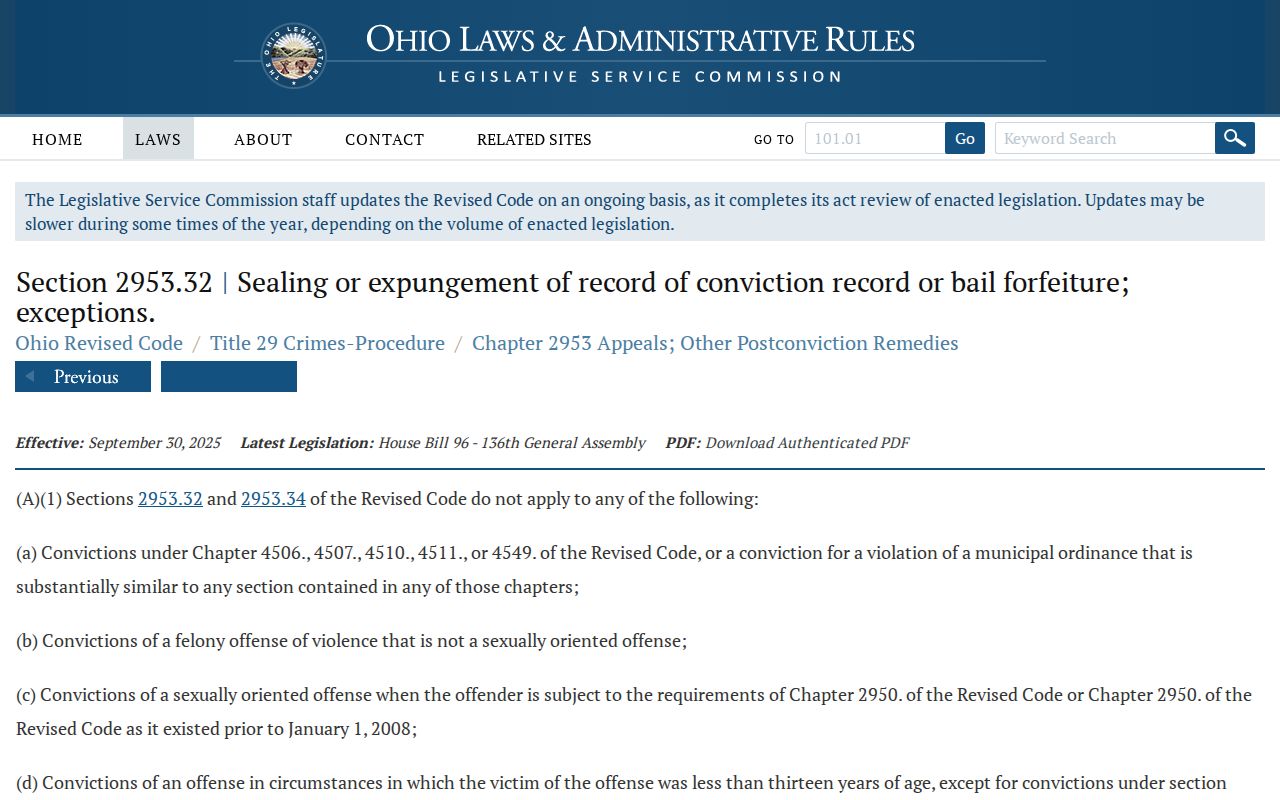
For an eligible adult conviction, R.C. § 2953.32 generally permits an application once the waiting period from final discharge runs. The period is three years. That covers one or two eligible third-degree felonies. It drops to one year for eligible fourth- or fifth-degree felonies and misdemeanors. A minor misdemeanor waits only six months. Certain improper-compensation convictions carry a seven-year wait, and registered sex-offense cases follow special periods. Exclusions or restrictions apply to many traffic, violent, sex, higher-degree, young-victim, domestic-violence, and multiple-conviction categories. The court weighs pending cases, rehabilitation, the government's interest, victim input, and statutory limits.
| Record or remedy | General timing or effect |
|---|---|
| Eligible adult conviction, sealing | Generally 3 years for one or two eligible F3 convictions; 1 year for eligible F4/F5 convictions and misdemeanors; 6 months for a minor misdemeanor. Exceptions apply. |
| Eligible adult conviction, expungement | Generally 10 years after eligible for sealing for an eligible felony; 1 year after final discharge for an eligible misdemeanor; 6 months for a minor misdemeanor. |
| Dismissal or not-guilty outcome | A person can generally apply after the dismissal or not-guilty entry under R.C. § 2953.33, subject to statutory exceptions and the court process. |
| Juvenile record | Chapter 2151 has a separate sealing and automatic-expungement process. Do not apply adult timing rules. |
Dismissed complaints and acquittals get their own statute. R.C. § 2953.33 covers both. A person can usually apply once the court enters the result, though exceptions apply. No-bills follow separate rules. So do pardons. Before granting relief, the court gives notice and holds the required hearing; the official Ohio sealing and expungement statute spells out current eligibility and the process.
The statute and the case order tell the full story.
Note: Eligibility depends on the case category, final discharge, exclusions, and court review, not just the name of a charge.
After an Ohio Seal or Expungement Order
A sealing or expungement order has real teeth. It reaches the court's records and the public offices tied to the case, official photo records included. The court also strips index references. By law, the proceeding is treated as though it never happened. One narrow exception applies. The Bureau of Criminal Investigation may keep an expunged fingerprint record for a limited law-enforcement use. Everyone served with the order must destroy, delete, or erase copies as the statute directs.
Private copies are a different matter. The order cannot reach a screenshot, a cached search result, a news story, or a copy held by an out-of-state company on its own. Send the order to each publisher. Ask it to comply. Once the original page changes, search engines offer an outdated-content process for cached results. Never promise that expungement erases the internet. It does not. A sealed record stays bound by the limits written into the actual order and statute.
For accurate reporting, use the court's exact disposition and date. If a seal or expungement order is provided, stop indexing the entry and its image, and follow a free, documented correction path.
Ohio Free Correction Routes
Ohio law and private publisher policies overlap, but they are not the same thing. Send any correction or opt-out to the publisher that controls the copy. Use its documented free process. Include the exact post plus records supporting the change. A private page never replaces the official court or agency record. Fix the source record first. Then ask secondary publishers to update their copies. No policy guarantees removal of an accurate, current public record.
| Publisher | Stated free process and limits |
|---|---|
| Busted Newspaper | Its form asks for contact details, the exact post URL, a reason, and proof. It lists free requests for expunged, dismissed, nolle-prossed, not-guilty, or sealed matters and reports a five-to-ten-day verification/removal window. An accurate current public entry may fall outside the policy. |
| RecentlyBooked | Its policy says there is no charge and lists dismissal, sealing or expungement, wrong-person, juvenile, duplicate, incorrect, and outdated entries. It asks for the record URL, name, arrest date, county, reason, and relevant documents. It says an accurate current public record outside those criteria may remain. |
| Mugshots.com | The policy says updates and removals are free. It lists sealing, expungement, identity theft, restriction, and other stated grounds, and asks for legible court papers and its record number. It reports up to ten business days for processing. A favorable case result should be documented, not described as an expungement unless one was ordered. |
| Arrests.org and Mugshots.zone | The Ohio research found no clearly documented, statewide free removal policy for Arrests.org and no confirmed statewide workflow for Mugshots.zone as of September 22, 2026. A contact page or removal link is not a promise of a free process or result. |
| Ohio newsrooms | The outlets reviewed had no dedicated mugshot opt-out policy on their public pages. Use the outlet's general correction or contact route for a factual error or a documented case outcome. A newsroom report is selective and is not a current roster. |
Keep a record of what you send. Save the source URL and the court or agency record attached to your request. An arrest story raises two possible asks: a factual correction, or the later outcome. The ask is never a demand to rewrite a lawful story. The available remedy depends on three things. Publisher policy, the official record, and any binding order all matter.
These free policies change, so read the live terms before sending personal information. Treat promises of universal removal with caution: Section 2927.22 creates no blanket takedown right, and a private offer cannot guarantee an official seal or erase copies held elsewhere.
Ohio Court Cases on Mugshot Access
The statute has a backstory. A Lucas County lawsuit sits at the center of it. In December 2012, a Toledo attorney filed a class action in Lucas County Common Pleas against several mugshot sites that charged removal fees. Reporting at the time laid out the claims. The defendants argued the sites were not then illegal. The case ended in a dismissal with prejudice after settlement activity. That history helps explain the 2018 law. The law targets payment demands rather than banning publication of arrest information outright.
Booking photos reached the Ohio Supreme Court too. In Shaffer v. Budish, 2018-Ohio-1539, the court weighed privacy against public access in a case involving a booking image with unusually intimate details. The justices found no categorical constitutional privacy right that bars publishing booking photos in every case. Room remains to balance a particular image and its context.
A 2022 case added another piece. In State ex rel. Cincinnati Enquirer v. Hamilton County, the court's public summary held that an office cannot stall public-record access by labeling ordinary incident facts "investigatory work product." The exceptions in § 149.43 stay fact-specific. The cases pull in both directions. A public office must justify withholding a record, and a publisher must protect material that law or court order makes confidential.
Note: A ruling about access to an agency record does not settle whether a private copy is accurate, current, or subject to a later court order.