
Ohio Busted Mugshots and Records
A booking photo gets taken at arrest intake. The local record then sits with whoever booked the person: a county sheriff, a municipal police department, or a regional jail. No statewide rule forces counties to post the photo online. Some do, some don't. The Ohio Department of Rehabilitation and Correction keeps its own separate picture for anyone in state custody or under its supervision. These images mark different stages of one record trail.
A roster name means one thing only. The agency reported a booking or a custody entry at a given time. People leave rosters after release or transfer. The charge itself can change. A court docket carries the later outcome. So before trusting an old photo or a one-line arrest entry, check the issuing agency and the court.
What Ohio Booking Records Show
Ohio has no single statewide booking form. County and regional systems expose different fields. The corrections profile covers someone sentenced or supervised instead. So treat the items here as a field guide: a public roster may omit some fields, label them differently, or reveal the photo only on a detail page.
| Record layer | Fields to check | What they mean |
|---|---|---|
| County or regional booking | Name, booking or subject number, booking date, in-custody flag | Identifies an intake or current roster entry. A current-custody flag can change after release, transfer, or a system refresh. |
| Local agency detail | Reporting or arresting agency, charge fields, photo or Photo/No Photo label | Greene County shows agency and charge details; Auglaize County exposes a photo field and an archive-search option. Other systems differ. |
| ODRC offender search | First and last name, county of commitment, residential county, ZIP, status, hearing month, offender number | Search fields for the state corrections population, not a county booking roster. |
| ODRC profile | Offender photo, admission date, status, institution or supervision, offense and sentence information | State prison and supervision history. The photo is not automatically the county booking image. |
| Court file | Case number, filing, arraignment, plea, dismissal or verdict, sentence, later sealing order | Shows the legal path after arrest. The clerk, not the jail roster, holds the case disposition. |
Ask for a missing item by name. A request for the booking sheet and photo may not return the release date or court result unless you name those records too. The arresting agency and the jail can each hold a different piece of the same event. One request often is not enough.
How to Request Ohio Booking Records
Public offices answer to the Ohio Public Records Act, R.C. § 149.43. Want an older booking or an unposted photo? Ask the current custodian for that exact record. Request an electronic copy if you prefer one. Keep the ask narrow so the office can actually locate the file.
- Identify the county jail, regional jail, or arresting police agency that likely created or holds the record. Use the county's official site when the arrest location is known.
- Give the person's name, approximate booking date, agency, and booking or case number if known. A name alone may match more than one person.
- List each item requested: booking sheet, booking photograph, charge or release record, and any linked incident number. Ask for the file in electronic form when available.
- If the agency withholds part of the record, ask it to cite the legal basis and provide any separable, redacted portion. Public-record law does not open juvenile, protected, or active investigative material.
- For an ODRC profile or prison record, use the department's Central Records or public-records route. County jail staff cannot certify an ODRC file.
Ohio offices may charge actual copying or media costs. No single statewide fee or response time applies. Records travel, too. If a file moved to a regional jail, ask both that jail and the arresting department which office holds the original. For an ODRC record, give the offender number and the exact profile item, then follow the department's disclosure limits.
Ohio's Mugshot Law in Practice
R.C. § 2927.22 is Ohio's anti-pay-to-remove law. It took effect in January 2018. The rule is simple. A publisher cannot negligently ask for or take payment from the person named in criminal-record information in exchange for removing, correcting, changing, or holding back that information. The statute defines a booking photograph. It also covers related identifying details and charges.
Still, it does not order every publisher to erase an accurate arrest entry once a case ends. The scope is narrow. A publisher simply cannot demand money from the subject as the price of a takedown or correction. The law does allow a civil claim for loss or harm and states its remedies. It is no general publication ban, and it never replaces a court order or a custodian's separate disclosure duties.
For an arrest record: check the source, the date, and the court outcome. Ohio's mugshot statute governs removal payments, not what a court later decides.
Commercial sites sparked the law. Reports said they kept old booking entries online and sought removal payments. A Lucas County fee suit came first, in 2012. The Ohio Supreme Court later weighed access against privacy in Shaffer v. Budish. In 2022, State ex rel. Cincinnati Enquirer v. Hamilton County stressed that ordinary incident records cannot be delayed just by calling them investigative work product. Access and privacy both count.
Sealed, Expunged, or Juvenile
Ohio treats sealing and expungement as two different things. An eligible adult conviction falls under R.C. § 2953.32, which sets waiting periods tied to the offense and the person's record. The statute allows one year for an eligible misdemeanor. One or two eligible third-degree felonies mean three years. Other categories wait longer. Plenty of offenses are excluded or restricted, so these periods never guarantee that a record qualifies. The court weighs the statutory factors and can still deny the application.
Dismissed charges and not-guilty findings take a separate route under R.C. § 2953.33. Juvenile records sit in Chapter 2151 instead. That chapter runs its own sealing and expungement framework. Ohio's juvenile rules generally call for automatic expungement five years after sealing or at age 23, whichever comes first, with statutory exceptions spelled out in R.C. § 2151.357 and R.C. § 2151.358. An adult roster never licenses a juvenile name or image.
A court order binds the agencies and courts it names. It does not erase a private publisher's copy, a saved screenshot, or a search-engine cache on its own. Mail a certified copy to the holder. Ask for compliance at no charge. When a case outcome is known, state it plainly; when it is not, say that too.
Ohio Busted Photos and Retention
Ohio has no single photo retention rule for county booking photos. Each local government follows an approved records schedule. Until the series is lawfully destroyed or transferred, the sheriff, police department, or regional jail controls it. The Ohio History Connection's Local Government Records Program explains how those schedules work. A missing photo can mean several things. The portal may show only current inmates. The vendor may have changed. Or the photo was lawfully destroyed, transferred to an archive, or sits behind a broken page.
County schedules show why a statewide number misleads. Belmont County ties one booking record with photo to a long post-release period, while an obsolete arrest-card series there may later go to archival appraisal. Lorain County's prisoner-record schedule uses a different period entirely. Both are local examples, not Ohio-wide rules. For older material, ask the originating custodian for the series name, approved schedule, and transfer history. The deeper Ohio archive path is set out on the Old Mugshot Archives page.
How to Find Ohio Busted Mugshots
Start with the facility that did the booking. Then chase the record to its current custodian. A county roster helps if the person may still be in custody. It is a narrow window. The roster is not a full history of every Ohio arrest, and a released person may be gone from it while the booking record stays with the agency.
- Match the likely county from the arrest location or agency. If the location is unclear, check nearby municipal departments and any regional jail serving that county.
- Search the official current-custody roster by name or booking number, then open the detail record to see whether a photo and booking date are shown.
- If the person has left the jail, check a recent-booking report or ask the custodian for the archived booking record and photo.
- If the person was sentenced to state prison or is under state supervision, search the Ohio Department of Rehabilitation and Correction by name, offender number, status, county, or ZIP.
- Use the relevant municipal or Common Pleas clerk to find the case outcome. A roster entry cannot show whether a charge was dismissed, reduced, or proved in court.
Trust the date and status the official source prints. A name match alone proves little. Compare the booking number, county, agency, and case details where lawfully available. If an online page shows nothing, request the record straight from the office that holds it.
Ohio Busted Mugshots Across County Rosters
No single county mugshot feed covers Ohio. The statewide picture is really a patchwork of sheriff systems, municipal records, regional jail portals, and records-request paths. Allen County's New World inquiry, Greene County's inmate search, Wood County's P2C catalog, and Auglaize County's gateway each look different. Some detail records include photos. Others expose a photo field, return text only, or never confirm an image at all. Every county picks its own design.
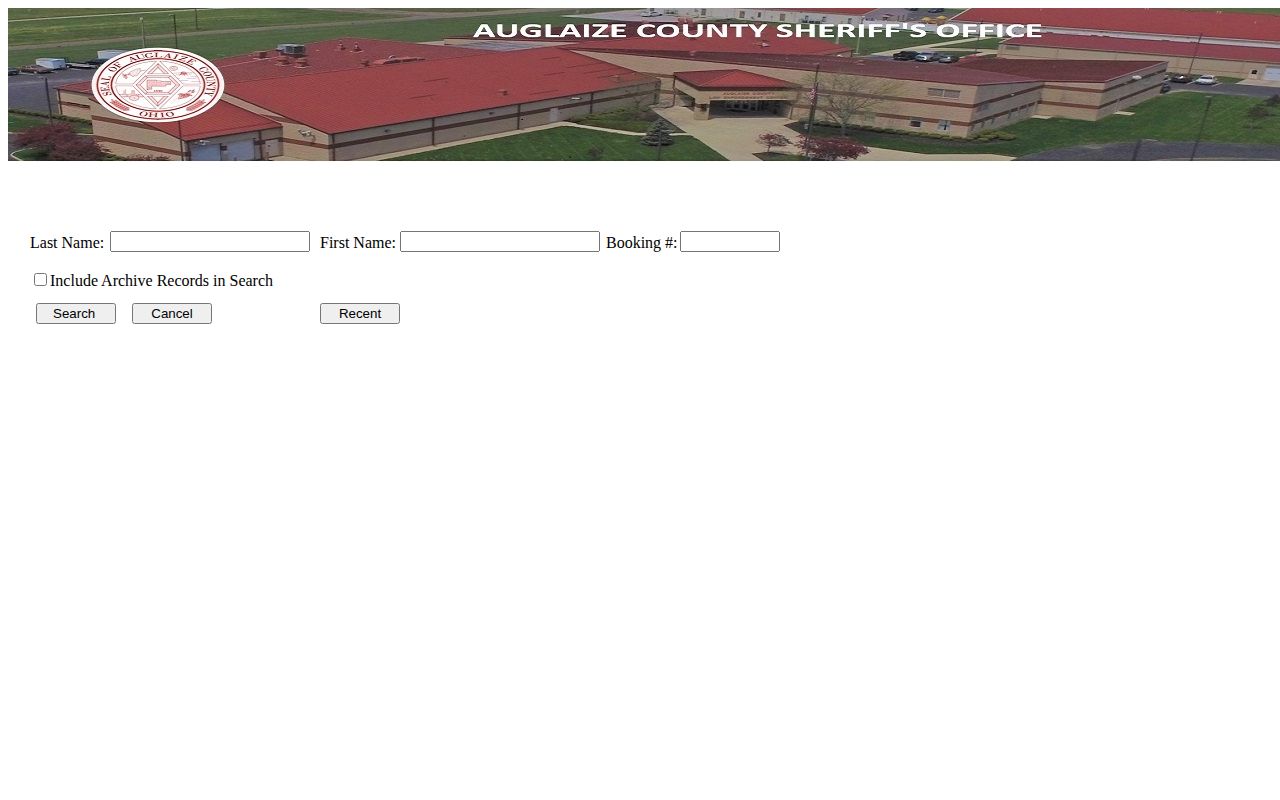
The Auglaize portal searches by last name, first name, and booking number. A checkbox adds archive records. That form shows how one county splits a current search from an older record view. The checkbox creates no permanent statewide archive. A missing result does not mean no booking occurred. The Auglaize County Inmate Records Search Gateway displays the search form and the archive option. The fields trace one county's real route into booking.
Other Ohio counties use separate vendors. Many rely on regional facilities, so the right start is the sheriff or jail for the place of arrest, not a state-level search that does not exist.
Why Ohio County Rosters Differ
Access tools differ, not legal standards. Big urban counties lean on searchable custody data, public-record portals, and connected court systems. Rural offices often work through a phone or email custodian. A basic list, a regional jail, a sheriff app, or no public image feed at all may be what a small county offers. An app built for alerts and tips is not a roster. Only a real booking dataset behind it counts.
Regional jails add a wrinkle. The Corrections Center of Northwest Ohio serves Defiance, Fulton, Henry, Lucas, and Williams counties. Tri-County Regional Jail handles Champaign, Madison, and Union. An arrest in one county can mean booking at another facility, so check both systems. Compare the arresting agency against the booking record. A regional entry carries its own number and update cycle.
Search screens differ too. Some portals filter by custody status or booking date. Others give you nothing but a name box. The OCN court network is an administrative data exchange, not a public case-image search for every county. Treat a feed's limits as source limits, never proof that an empty slot meant no booking.
Which Ohio Rosters Show Photos?
Even counties sharing a vendor split on photos. Greene County's inmate search carries a photo link. It can show reporting agency and charge fields. Allen County puts a photo section on its detail screen. Auglaize adds an explicit photo or no-photo field plus an archive option. CCNO's current roster stays mostly text. Its prior-day and seven-day booking reports are the ones with photos. Clark County's Miami Valley Jail system posts a current roster and an update indicator. It is documented as having no mugshots.
That patchwork is why "Ohio mugshots" is no single database. A photo label guarantees nothing. A current roster can drop a booking after release. When the official portal shows no photograph, ask the custodian whether one exists. Ask too whether R.C. § 149.43 requires its release. A third-party copy never proves the government disclosed that image.
Auglaize's gateway is a tidy example. Its archive choice is visible without showing any person's image. The search design and the photo policy sit apart. Photo display still depends on the record returned by the county system.
Ohio Recent Booking Feed Windows
Rosters and booking reports cover different windows. CCNO runs a live inmate search plus prior-day and prior-seven-day reports. Those reports keep a booking visible after someone leaves custody. They are not permanent archives. Other counties offer only a custody snapshot, a recent window, a photo marker, or nothing public. Ohio sets no shared posting time or update schedule.
Weekends and holidays can shift the timing. A booking may wait for transfer or data entry. Some portals display update indicators, but no statewide freshness promise backs them. Note the source date on any result. A name that vanishes might mean release, transfer, a court move, data cleanup, or a vendor refresh. It says nothing about the case outcome.
The official source controls the record. When an online report ages out, ask the jail or arresting agency for the exact booking date and record series. A request to the right custodian beats assuming an empty search means no arrest.
Ohio Courts After a Booking
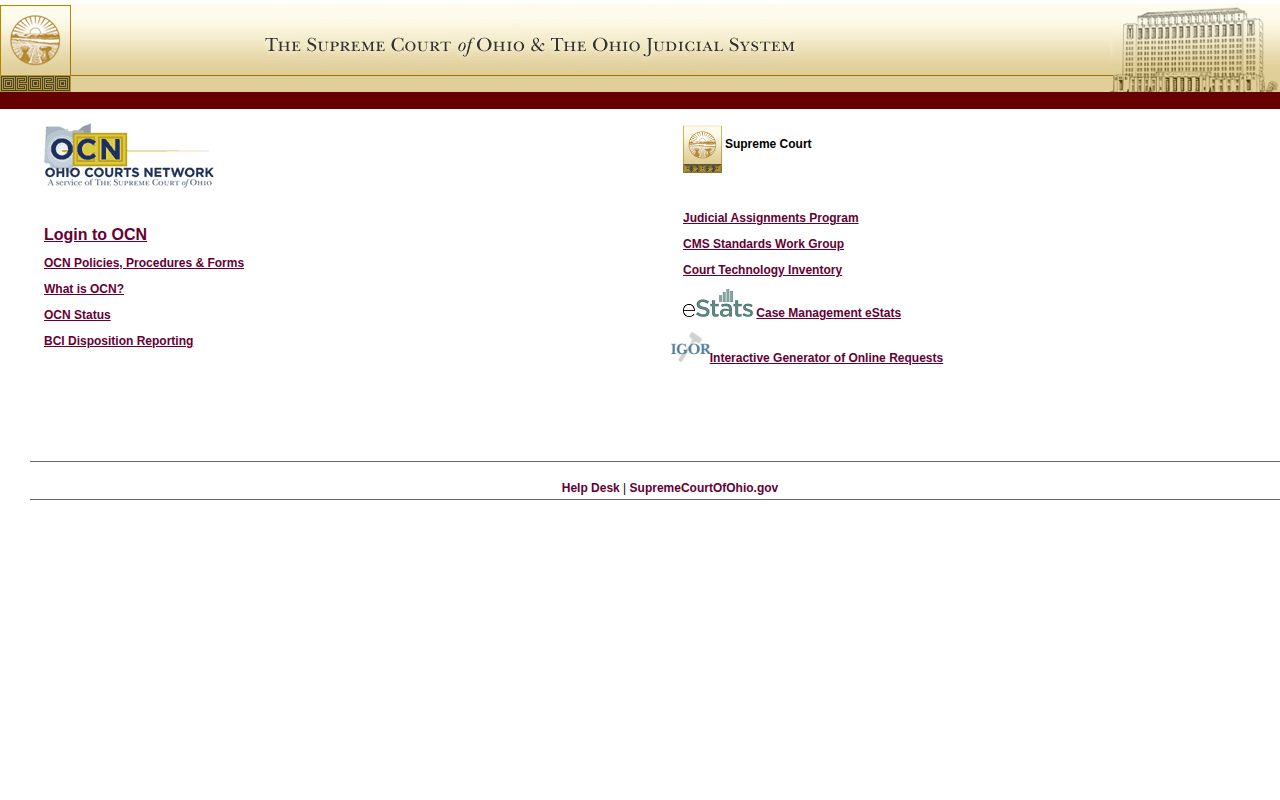
Jail and clerk answer different questions. A roster shows booking or custody. The court file holds the rest. Arraignment, bond, plea, dismissal, verdict, sentence, and later sealing or expungement all live there. Ohio has no single free statewide trial-court docket. Nothing replaces a local clerk. The Supreme Court of Ohio posts appellate dockets, opinions, and a county court directory. The Ohio Courts portal lays out the Ohio Courts Network and its state court resources. It helps you find the right system. It does not promise full public case files for every county.
For a county arrest, check both the municipal court and the Common Pleas clerk. Pick the one matching place and case type. Search by case number, not just the name. Read the procedural entries. A felony can move from municipal court to Common Pleas, and an appeal may still change the result after trial.
Ohio State Prison Photos and Status
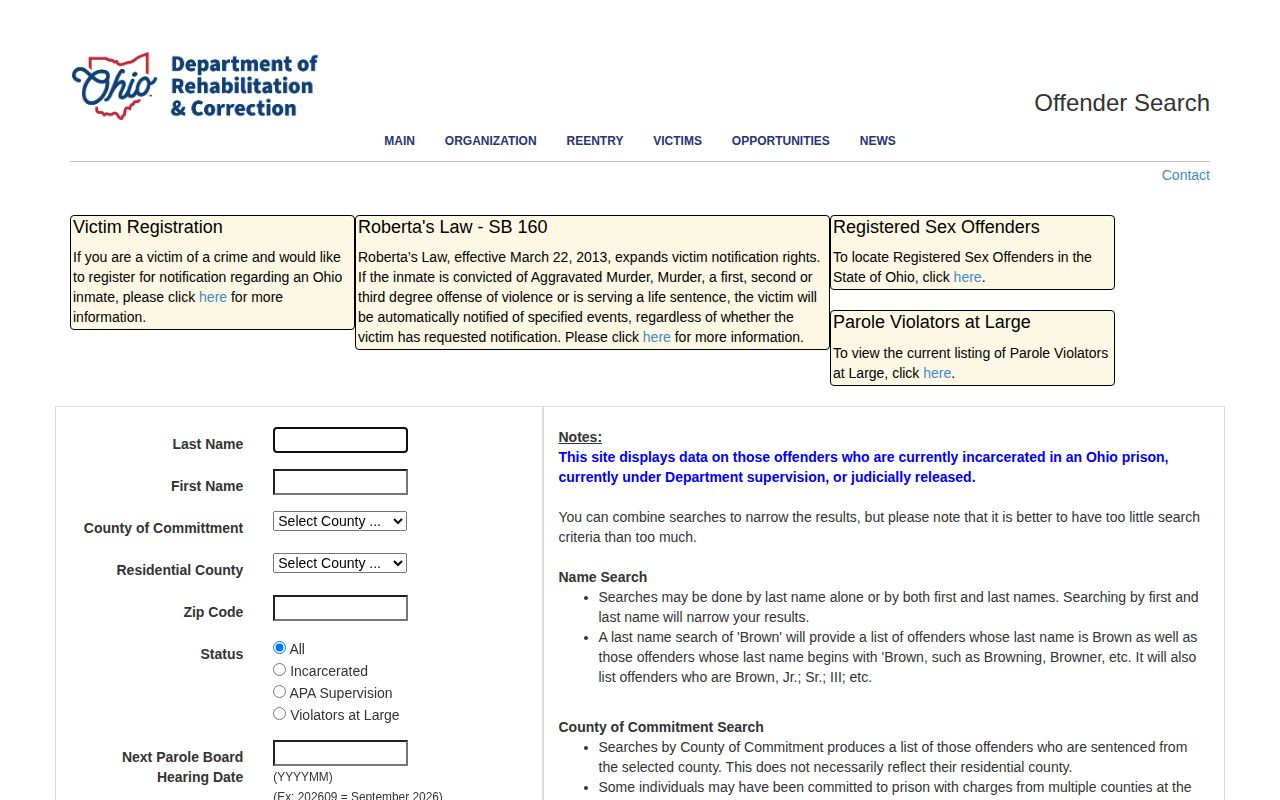
Ohio's state prison system keeps its own records, separate from county jails. The ODRC offender search is the doorway to them. It covers people incarcerated in an Ohio prison, held under department supervision, or judicially released. County booking searches live elsewhere entirely. Filters include first and last name, county of commitment, residential county, ZIP code, status, next parole-board hearing month, and ODRC offender number. Status options run from All through Incarcerated, Released, APA Supervision, and Violators at Large.
The department warns that its data can lag. County of commitment is where the sentence was imposed, not always where the person lives. Residential county and ZIP reflect a last recorded address. Neither one marks a current location. The profile's Offender Photo is a corrections image, and it should not be read as the county booking photograph unless the agency confirms that source.
The ODRC offender search carries the official fields and status choices. Someone marked Released, or under Adult Parole Authority supervision, can stay searchable after leaving prison. A state profile is not a jail roster. Different custodians hold them.
Missing, sealed, or disputed detail needs the right office. Contact ODRC through its public-records or Central Records route and cite the offender number plus the exact item you want.
Busted, Released, or in State Custody
Custody determines the record source. A person can be booked into a county or regional jail, later released, or sentenced into the state system. Federal custody follows a separate path. Treat the table as a routing aid that points you toward the right record holder.
| Record state | First source to check | What a result can establish |
|---|---|---|
| Recently booked or still in county custody | County sheriff, jail, or regional roster | A booking or custody entry as reported at the displayed time. Photo availability varies. |
| Released from a county jail | Booking record request to the jail or arresting agency | The agency may retain a record after the person leaves the current roster; the request is separate from custody confirmation. |
| Sentenced or supervised by Ohio | ODRC offender search and profile | State corrections status and profile fields, which may lag and may remain available after release. |
| Federal custody | Bureau of Prisons locator; ICE locator for immigration custody | Federal custody locator results. Neither is an Ohio county booking-photo feed. |
A transfer can split the picture. Two systems may show different statuses for the same person at the same moment, so confirm with the current custodian before treating any roster as a live custody statement.
Ohio Federal and ICE Locators
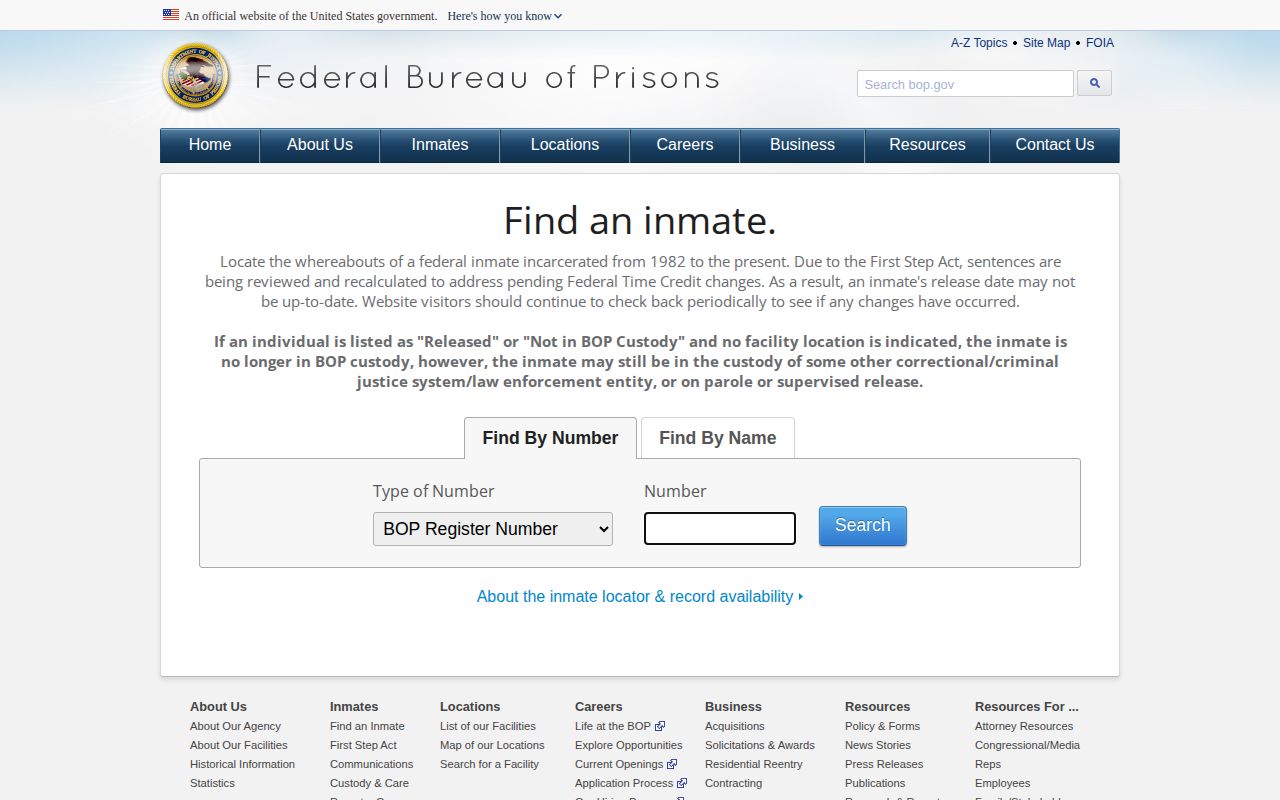
The Bureau of Prisons locator handles federal custody only. County jail bookings are not part of it. Nor does the public search offer a mugshot feed. Someone can lack a federal locator photo. That can happen even when a local agency once took a booking picture. The Federal Bureau of Prisons explains its record limits. It also runs a separate FOIA path for federal files. A missing photo should stay missing. News portraits and unofficial images never belong in its place. The BOP inmate locator starts from a federal register number or a plain name search. The page itself warns about a released status or a blank facility. Either can mean the person left BOP custody while another system still holds him.
ICE's Online Detainee Locator is a narrow tool. It generally wants an A-number plus country of birth, or an exact name plus country of birth, and may ask for a birth date. Coverage reaches current and some recently released federal immigration custody. Minors and timing create gaps. ICE publishes no public mugshot feed.
Ohio Wanted Lists and Warrant Checks
Ohio has no statewide public warrant database. LEADS stays locked to authorized law enforcement. That leaves a patchwork of sources. Public sheriff wanted pages list only the people and cases those offices choose. ODRC's Parole Violators at Large page is a corrections status list, not a universal warrant search. The Marshals list is federal, not Ohio. None of them covers every case.
For a specific concern, start with the county and the issuing court. Then call that county's clerk or its official warrants unit. A name-only search cannot clear a warrant. An absent name is not proof of no warrant. Someone who believes a warrant is wrong should work through the court or legal counsel. Never approach a listed person or act on the notice yourself. The issuing agency's notice and date always control, and the Most Wanted page lays out the statewide lists and safe next steps.
Ohio News and Third-Party Arrest Pages
Go official first. Sheriff rosters, record requests, and court dockets outrank everything else. Newsrooms and private publishers pick and choose. They sit incomplete, duplicated, or stale. Many never mention the final court outcome. A private page simply reflects whatever its publisher posted. Read them as pointers, not records.
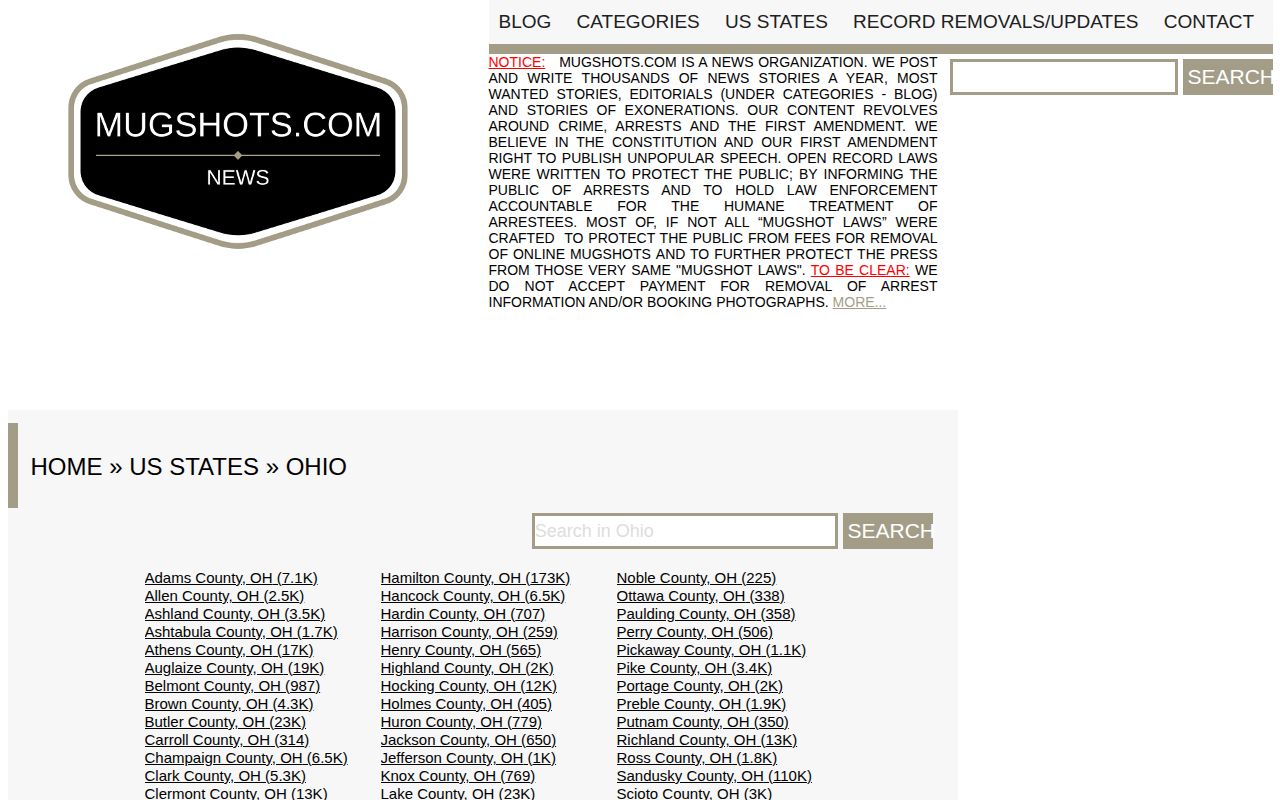
The Mugshots.com Ohio page is a private secondary index rather than any official count of Ohio bookings. RecentlyBooked describes a past-30-day county model. It does not cover every county. Busted Newspaper's county coverage runs uneven. Arrests.org is partial, too, with a facial-search feature best skipped. Mugshots.zone's Ohio landing page is no stable statewide index. None of these sites replaces the source sheriff, jail, or court.
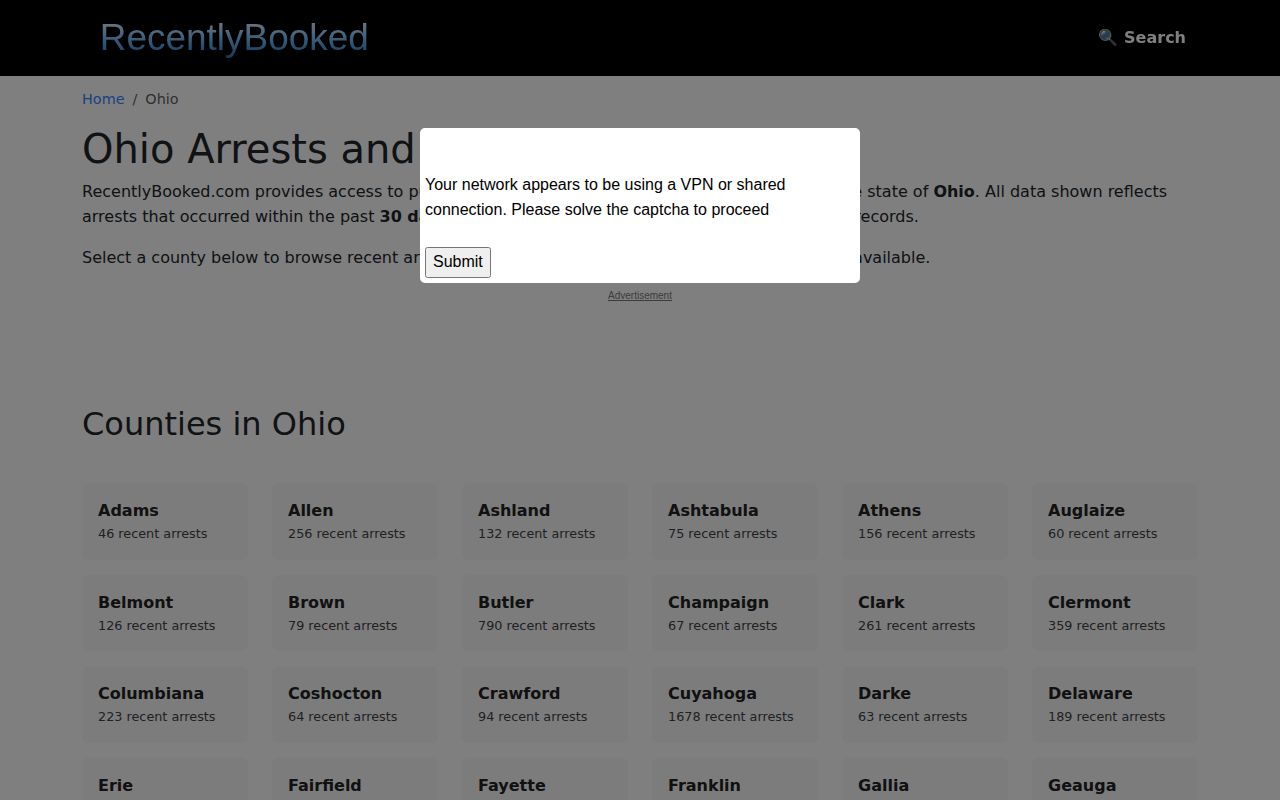
The RecentlyBooked Ohio page offers another secondary coverage map. It is no official roster. Its county list is partial, and any number shown is the publisher's own count rather than a government booking total.
The Mugshots.com policy page sets out a free update or removal route for certain outcomes and documentation. It is not a statewide process or guarantee.
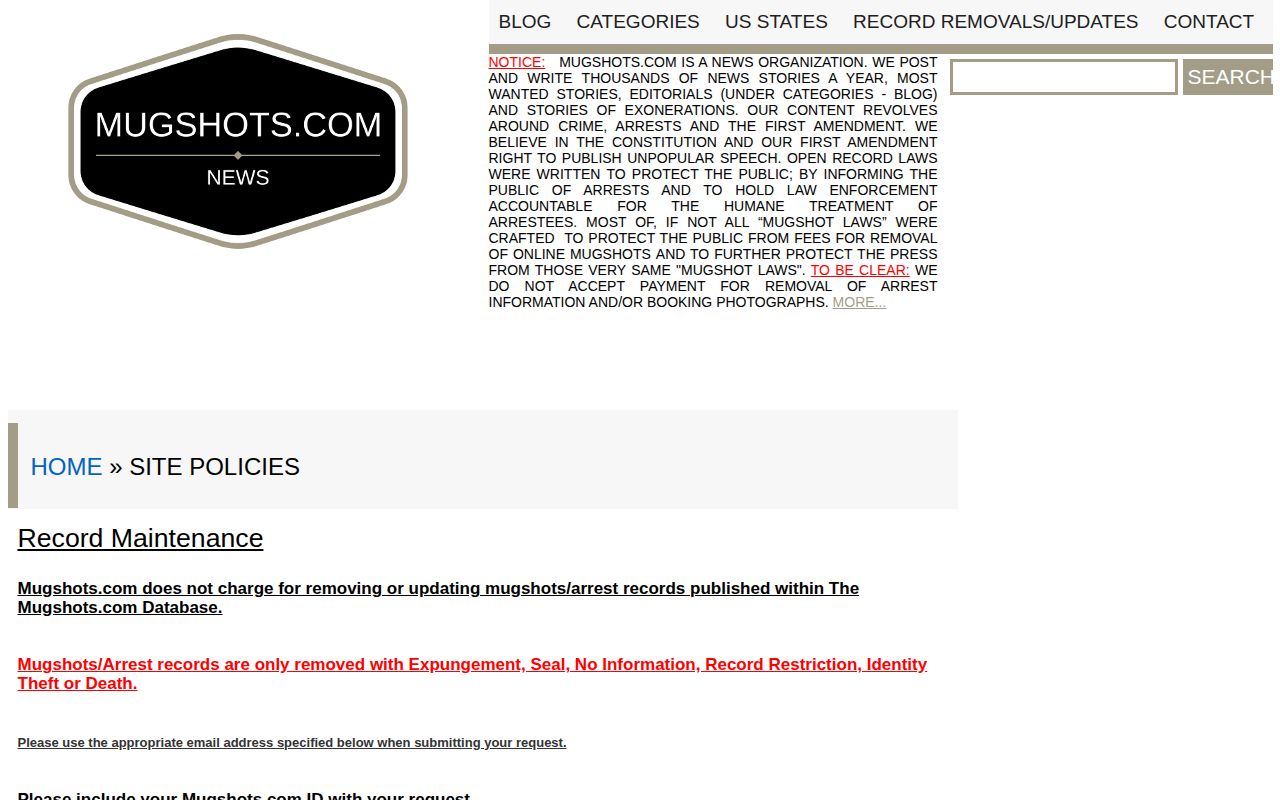
Private arrest sites each set their own removal rules, and they differ widely. Busted Newspaper waives fees for certain outcomes when you send proof. RecentlyBooked offers free updates for an expungement, a wrong-person listing, or a duplicate. Mugshots.com states plainly that its policy charges nothing. Arrests.org and Mugshots.zone list no statewide free process at all. So never pay a middleman, and expect a private publisher to demand evidence before acting.
Ohio newsrooms take a different route entirely. They publish selected stories rather than full booking feeds. WHIO serves Dayton and the Miami Valley. The Springfield News-Sun, Cleveland.com, Columbus Dispatch, Cincinnati Enquirer, Akron Beacon Journal, and Toledo Blade each cover their own regions. A photo in a story may come from an agency or a prosecutor. It may also come from a wire service or the newsroom itself. Trace any claim back to the originating record and court disposition before repeating it.
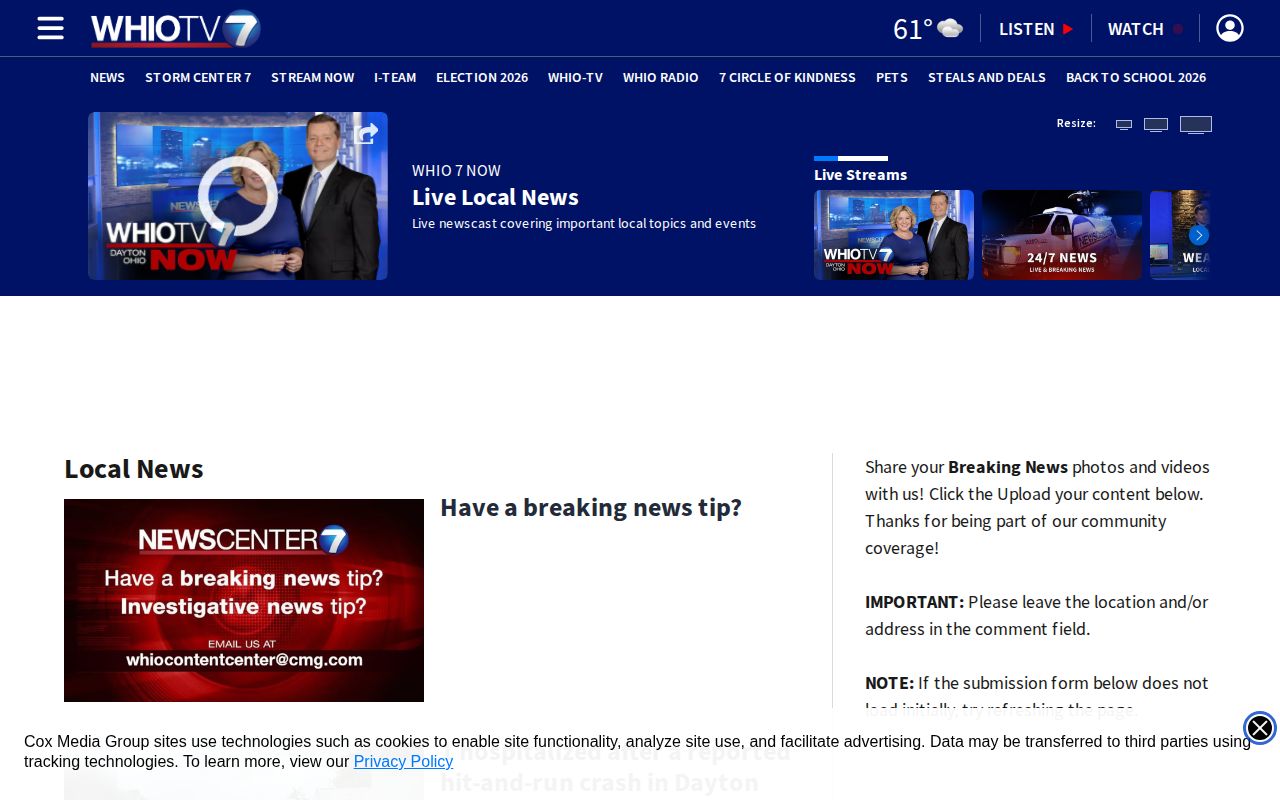
The WHIO local-news page shown here is an editorial section, not a mugshot database. Coverage there is selective. Agency-supplied photos are common.
Start with the publisher when an entry is wrong. Attach the official docket or agency correction to your request. A free takedown is never guaranteed, so describe any favorable court result in precise terms.
Ohio County Busted Mugshots by Source
Every booking starts with the agency that made the arrest. The county or regional jail may then post a custody list or booking report. Court clerks hold the case outcome. ODRC runs the state-prison layer after sentencing. Federal agencies keep custody records of their own. The right source depends on the date, the county, and the custody status, not the person's name.
Some city police departments log arrests separately. The county jail still holds the booking record. County subdomain pages lay out each local agency and its feeds. For a statewide path, open the Ohio County Directory. Pick the county where the arrest happened. Follow its official sheriff, jail, or clerk link. A city name can narrow down the arresting agency, though the county system may hold the intake record.
Old photographs are a separate hunt. A local records schedule or the Ohio History Connection may show whether the file moved. A current roster link will not carry you to an archive. Start with the original custodian. Ask what series survives. Request the final disposition apart from the booking image.